

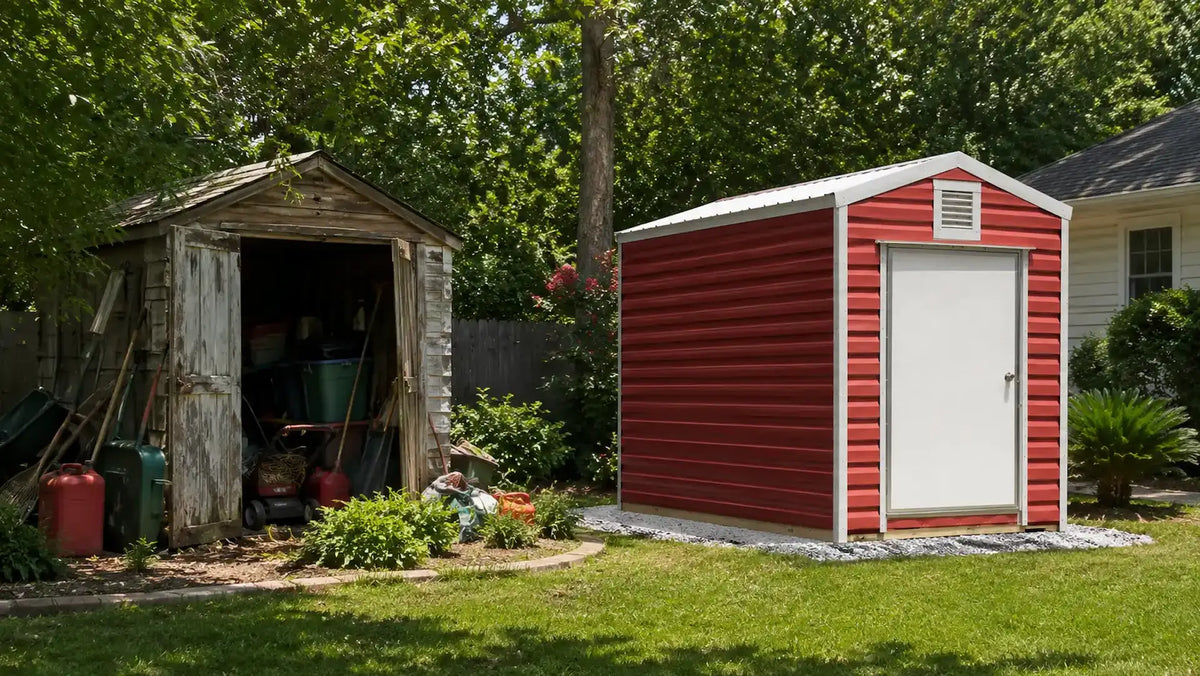
If you're constantly moving things around, running out of room, or dealing with leaks and rot, your backyard shed is probably telling you something: it's time for an upgrade. Most of these problems have a straightforward fix, more space, better features, and a steel-framed building built to handle Southeast weather without the constant upkeep.
Here are seven signs your shed has reached its limit, along with the upgrade options that actually solve each one.
What should you know about upgrading a backyard shed?
-
Running out of space, constant repairs, and weather damage are the clearest signs it's time for an upgrade.
-
Steel-framed buildings solve most of these problems at the source, more durability and less maintenance than wood.
-
Upgrade options like loft storage, wider doors, and better ventilation add function without needing a much bigger building.
-
Repairing an undersized or aging shed often costs more over time than upgrading to something built to last.
You can browse available sizes and styles in Action Buildings' full collection of portable buildings.
7 signs your backyard shed isn't enough
Here's what to look for, and what actually fixes it.
1. You're constantly running out of storage space
If you're stacking items outside the shed, cramming things into the garage, or simply running out of floor space, that's the clearest sign of all. If you find yourself squeezing new purchases in wherever they'll fit, or storing anything at all outside the shed itself, the building has already been outgrown. Upgrade option: a larger footprint or loft storage adds real capacity without taking over more of the yard.
2. You can't keep things organized
When everything gets piled in front of everything else, it's not a you problem, it's a layout problem. That usually looks like digging through three bins to find one thing, or giving up and just buying a replacement instead of hunting for what you already own. Upgrade option: shelving systems and a customizable layout give every item its own spot, so you're not unpacking the whole shed to find one thing.
3. You're dealing with leaks, rot, termites, or mold
Wood sheds are especially prone to moisture damage in the Southeast, and once rot or termites set in, the problem only spreads. Upgrade option: a steel-framed building resists moisture, pests, and mold from the start. For a closer look at how humidity affects different materials, see our guide on which portable storage buildings resist humidity and mold. Watch for soft or discolored wood, a musty smell, or gaps where pests could get in, these are early warnings before the damage becomes structural.
4. You're spending too much time and money on repairs
New boards, resealing, pest treatment, roof patches, it adds up, and it never actually makes the shed bigger. If you've replaced the same board twice or resealed the roof more than once, you're not maintaining the shed anymore, you're managing a slow decline. Upgrade option: a steel building cuts most of that maintenance out entirely, so your money goes toward using the space instead of patching it.
5. You need more workspace, not just storage
If you're doing projects on a tarp in the driveway because there's no room inside the shed, storage was never really the issue, workspace is. Workspace problems often show up as tools stored in one place and used in another, which turns every project into extra setup and cleanup time. Upgrade option: a workbench, added ventilation, and an electrical package turn a storage shed into a space you can actually work in.
6. You worry about weather damage every storm season
If every forecast has you checking on the shed roof or wondering whether water got in again, that's not peace of mind, that's a maintenance habit you shouldn't need. A shed that needs a tarp thrown over it before every storm isn't protecting anything, it's just delaying the next repair. Upgrade option: steel construction combined with good site placement and drainage holds up through heavy rain and wind with far less worry.
7. You've outgrown the shed as life has changed
A growing family, a new hobby, or a small business that's taken off can all outpace a shed that was sized for a much simpler set of needs. What fit a couple of bikes and a mower five years ago rarely fits a woodworking hobby, a side business, or a second vehicle today. Upgrade option: a custom layout and larger building sized around how you actually live now, not how you lived when you bought the original shed.
What should you think about before upgrading your shed?
Once you've spotted a sign or two above, a few questions can help you plan the right upgrade instead of just a bigger version of the same problem:
-
How much space you actually need right now, not just today's clutter
-
Whether your storage needs are likely to keep growing
-
Which of the signs above matter most for your situation
-
Your budget, and whether financing makes sense for the size you need
-
Where the new building will sit, and whether the site has good drainage and airflow
Thinking through these upfront makes it a lot easier to land on a building that solves the problem for good instead of needing another upgrade in a few years.
Why do steel-framed buildings outperform wood sheds long-term?
Steel-framed storage buildings hold up better and cost less to own over time than wood sheds, especially in the Southeast:
| Factor | Steel-Framed Building | Wood Shed |
|---|---|---|
| Moisture & rot resistance | Strong | Low |
| Termite & pest resistance | Strong | Low |
| Fire resistance | Better | Lower |
| Maintenance needed | Low | Moderate to high |
| Typical lifespan | Decades with basic care | Depends heavily on upkeep |
Is it worth upgrading, or should you repair your current shed?
If you're only fixing minor cosmetic issues, repairing may still make sense. But once repairs are addressing rot, structural damage, or the same leak more than once, you're usually paying to maintain a problem instead of solving it.
Repair may still be the right call if:
-
The shed is structurally sound and the issue is cosmetic, a chipped door, faded paint, a squeaky hinge
-
You're not dealing with any of the seven signs above
-
The shed still comfortably fits everything you need to store
Upgrading is usually the better move if:
-
You're repairing the same rot, leak, or pest problem more than once
-
The shed is too small no matter how it's organized
-
Repair costs are creeping toward what a new building would cost
-
The building no longer matches how you actually use your yard
Upgrading costs more upfront, but it typically costs less over the life of the building because a steel structure needs far less repair, and it solves the space problem that repairs never touch.
Which Action Buildings option solves these problems?
For most of the signs above, a steel shed with the right layout solves the space, organization, and durability problems at once. If vehicles or larger equipment are part of the picture, a portable garage adds wider doors and more open floor space
.
For a closer look at specific upgrades, like loft storage, roll-up doors, and electrical packages, and which ones fit which use case, check out our guide on backyard storage building upgrades.
Why choose Action Buildings for your shed upgrade?
Action Buildings builds steel portable buildings designed to solve these exact problems, more space, better organization, and lasting durability against Southeast weather.
You can explore options at one of Action Buildings' locations, review financing options, or request a quote to get started.
Frequently Asked Questions About Upgrading a Backyard Shed
How do I know if my shed is too small?
If items are stacked outside, hard to reach, or spilling into the garage, that's a clear sign the shed no longer fits your storage needs.
Is it cheaper to repair a shed or replace it?
Occasional minor repairs can be cheaper short-term. But repeated repairs on rot, pests, or leaks usually cost more over time than upgrading to a steel building that doesn't have those problems.
How long does a steel storage building last compared to wood?
A steel building can last decades with basic care, since it resists the moisture, pests, and rot that shorten a wood shed's lifespan
Can I upgrade my shed without a bigger footprint?
Yes. Loft storage, shelving, and a better layout can add usable space and organization without expanding the building's footprint.
What's the biggest warning sign that it's time to upgrade?
Ongoing moisture, rot, or pest issues tend to be the strongest signal, since those problems only get worse and are far more costly to manage in a wood shed than in a steel building.
Can I finance a new backyard shed?
Yes. Action Buildings offers financing options to help make an upgrade more manageable.
Final answer: what are the signs it's time to upgrade your backyard shed?
Running out of space, ongoing repairs, moisture or pest damage, storm worry, and simply outgrowing the building are the clearest signs your backyard shed isn't enough anymore. A steel-framed building solves those problems at the source, more space, less maintenance, and durability built for Southeast weather.
If your shed is showing more than one of these signs, explore Action Buildings' portable building collection or request a quote to find a building that actually keeps up with you.


Share:
Are Portable Storage Buildings Good for Yard Tools & Mowers?
Which Portable Storage Buildings Resist Humidity & Mold?